
About the Artist| Milla Lee
Milla Lee is an interdisciplinary artist working across performance, installation, and moving image. She is of Amis descent, from the Takidis community in Taimali, and of Indonesian Chinese heritage. She treats the body as the central site of perception and transformation. She has long worked in depth with historical trauma and collective memory, and explores the symbiotic relationship between humans and nature. Her work grows out of a long inquiry into the nature of life. Through it, she responds to the alienation of the bodily senses under the domination of contemporary capital and technology. With a care shaped by decolonial awareness, she seeks to call viewers back into deep connection with the land, with history, and with all things. In recent years she has been active internationally, invited to residencies and presentations in places including Yogyakarta, Indonesia, and Tokyo, Aomori, and Ishinomaki, Japan. In 2025 she received an international exchange grant from the National Culture and Arts Foundation (NCAF) to work in Japan and was a finalist in the Taoyuan Fine Arts Exhibition. That same year, the jury of Cine+Perfo 2025, an international festival of performance art and video performance in Argentina, selected her work for exhibition.
Activity Outline
Activity Outline
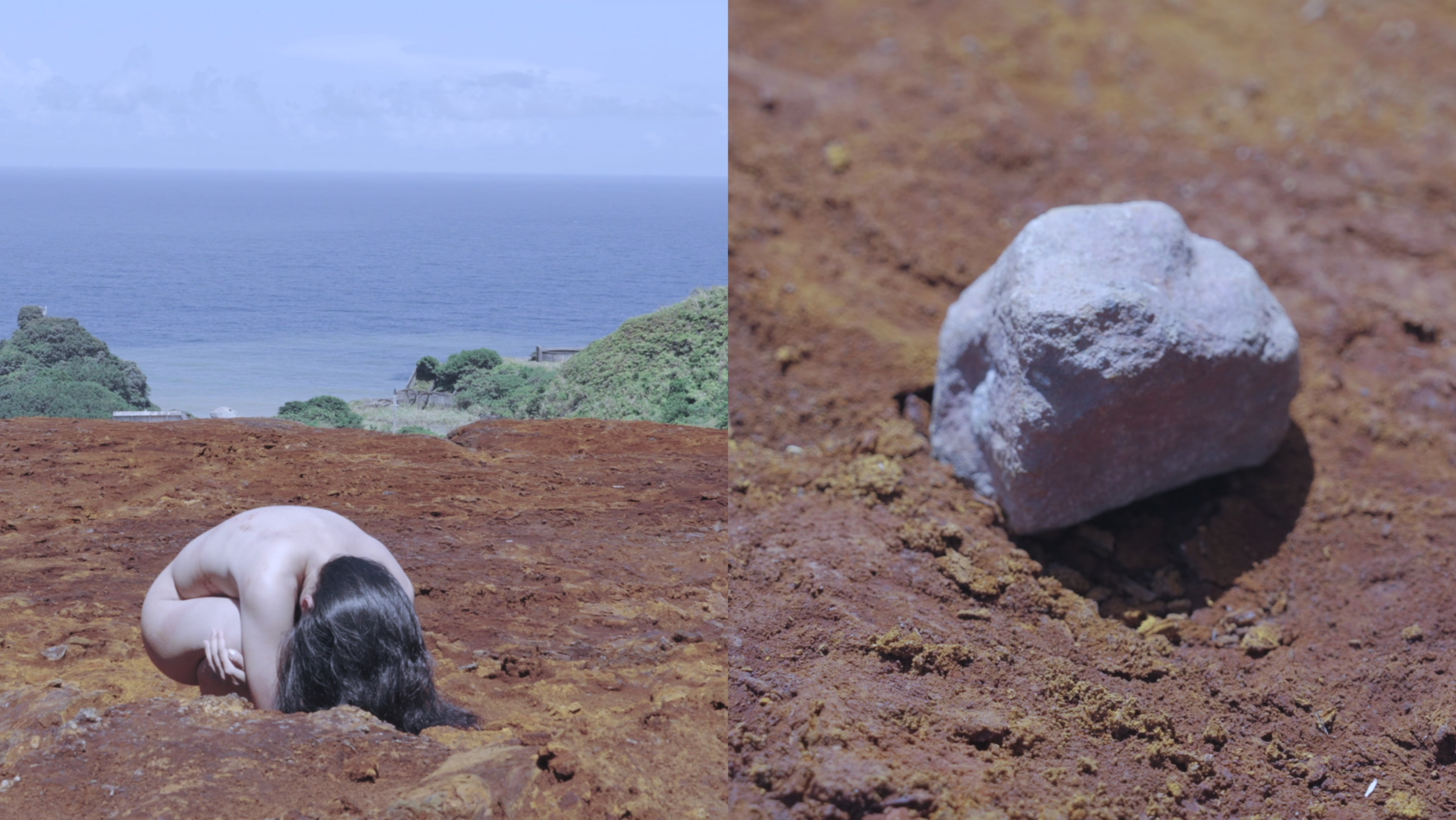
The workshop starts from the artist’s work Origin Is Not a Place — Transplanted Ecologies. She shares her experience of going back to her community to learn Amis knowledge of wild vegetables, and introduces how body, time, space, and object relate to one another in performance art. Participants then share their own life stories and cultural memories, reflecting on their ties to family, land, and the places they live.
We begin with a warm-up that brings attention to the body and the land. Through walking, breathing, and shifts in speed and center of gravity, participants feel how their bodies meet the ground and become aware of the space around them in a new way. Then, working with the weight, material, temperature, and shape of different objects, they explore how objects change the way we stand and move, and think about the memories of land, people’s labor, and life experience that objects carry.
In the transplanting and adapting exercise, participants move objects to unfamiliar places and watch how body, object, and space find new relationships, noticing the changes, adjustments, and negotiations along the way. Finally, each participant chooses one object, one spot in the room, and one or two main actions. Drawing on their own experience of land, cultural memory, and bodily sensation, they create a personal performance piece. Everyone then presents their piece and shares what moving, adapting, resisting, and rebuilding relationships mean to them.
The workshop invites you to start from your everyday body and the objects around you, and to feel anew your relationship to land, culture, and the place you are in now. Together, we explore how each of us, living, moving, and adapting in different places, carries our memories while building connections with new surroundings.
Capacity
15–20 people
Suitable For
General public; no performance art experience required
Admission
Free registration
Preparation & Notes
Please bring one everyday object that has traveled with you, or that holds memories of home, land, culture, growing up, or daily life.
Choose something you can easily carry and move on your own, sturdy and safe to handle: old clothes, a piece of fabric, a cup, a container, rope, a bag, or a small household tool. Objects may be placed on the floor, moved, or reused during the workshop, so please do not bring anything valuable, fragile, sharp, or irreplaceable.