
Co-Curator|Jo-Yu Hsu , I-Wen Chang
A Gesture of Invitation
The MASA’OPO Arts Festival, organized by the Taoyuan Indigenous Peoples Development Foundation, takes its core idea from the Amis word masa’opo: to gather, to come together, to meet. The word is open by nature. It describes not a closed event but something that keeps happening, a moment when people, sounds, bodies, and the different senses of time held by different cultures are allowed to draw close to one another for a while.
Sentient Guests: Walking, Eating, Worlding, the festival’s place-based performance section, takes up this question of gathering and pushes it one step further. When we speak of a gathering, who exactly is gathering? What if it is not only people? What if the land, the ancestral spirits, the spirit of food, and even directions and space themselves are present too? Then being a guest is no longer only a social relationship. It becomes a relationship with the world in a much wider sense.
Being a guest is where a relationship begins, and it also implies a clear line: the guest arrives, the host welcomes them, and for the time they share, both negotiate their places, share food and space, and acknowledge each other’s presence. In some cultures, though, this line is not so fixed. Could the land also be a visitor? Might the ancestral spirits return at certain moments? These questions are not easy to answer, but they are where this program begins.
Sentient Guests is not a fixed concept but an invitation to reimagine relationship itself. This year the festival presents four performance works from different cultural contexts. Together they ask a question the world today urgently needs to face: when we say “relationship,” whom do we mean? The festival’s central claim is this: Indigenous ways of being have never treated humans as the only subjects. Land, other-than-human beings, ancestral spirits, and mountain spirits all take an active part in a web of relationships. Performance, as a way of knowing through the body, is where these relationships can appear and be felt.
Walking, Eating, Worlding: Three Ontological Actions and Spaces
In the title, “Walking, Eating, Worlding” are not three separate themes. They are three ways of entering the world, or three ways the body relates to its surroundings: three ontological acts that make it possible for “sentient guests” to arrive.
Walking is first of all a bodily act, but it also draws out the bond between memory and landscape. It is how the body leaves its mark on the land, and how the land speaks through the body. As we walk, gravity gives the body’s weight a place on the ground. Walking is therefore not just movement but a way of knowing: where the feet step, memory wakes; the rhythm of the steps carries the ancestors’ sense of time.
Eating is one of the most everyday rituals of relationship, and also one of the oldest and most powerful. To eat is to take the outside world into ourselves, and to admit that our bodies have never been closed systems. They are always sharing and exchanging with the land, with plants and animals, and with the world of spirits. This is why seeing food through Unseen Relations lies at the heart of many Indigenous cosmologies: eating is an ethical act of exchange, part of how communities gather and socialize, and the key to staying alive.
Worlding (界, jie) needs a little more explanation. We use the Chinese character jie to mean separation, protection, and limits in space, though even this may not be the whole story: sometimes it is a ritual boundary, sometimes only a distinction people are willing to believe in for a while. The idea comes from traditional beliefs and religious ritual, where jie corresponds to spatial separation, sacred taboo, and the protection of the spirit realm. Ritual acts mark the inside and outside of a sacred domain, enclosing what is sacred and taboo and keeping out what is not. Setting up a jie makes a space sacred. It marks a clear difference between ordinary space and ritual space: it creates relationships while drawing distinctions, and it opens while it protects. The English word “worlding,” meaning “the making of a world,” suggests that the world is not a territory with fixed borders but a process that keeps emerging as beings meet and create together through relationships, practices, and ways of being. Different beings (people, animals, plants, land) all take part in making the world, with no single, central point of view: a multi-species, multi-ontological “worlding together.” In this festival, then, jie turns the performance site into a sacred space opened through ritual. It invites all beings to take their seats, while making clear that this moment is special and not to be taken lightly.
Theoretical Frameworks: Cosmopolitics, Oceanic Thought, and Choreographies of Relation
To understand the works commissioned and created on site for this festival, we draw on three theoretical frameworks that echo one another.
Anthropologist Marisol de la Cadena developed the concepts of “earth-beings” and “cosmopolitics.” She shows that for the Runakuna of the Andean highlands in South America, mountains, rivers, and rocks are not the “inanimate natural matter” of modern science. They are other-than-human beings with perception and subjectivity, living with humans in relationships of mutual care. Indigenous politics, she argues, has therefore never been a matter “among humans” alone: it brings land, mountain spirits, and ancestral spirits into politics as subjects. This directly challenges the human-centered idea of the “public sphere” in Western political philosophy. If mountain spirits are political actors too, and the land has a will, then the table of democratic deliberation must be widened to make room for other-than-human voices.
Pacific studies scholar Epeli Hau’ofa, in his classic essay “Our Sea of Islands,” sees the ocean as a space of relationship through which Indigenous peoples move between communities and islands. Taking the ocean as the center, his “sea of islands” counters the colonial geography that saw islands as small and isolated, “islands in a far sea.” Hau’ofa reminds us that Indigenous peoples never saw their worlds as closed islands. They moved, traded, and built kinship across a vast ocean network. The ocean is a road and a connection, not a barrier. This relational view of geography does not take national borders as its unit. Instead, it is held together by the movement of bodies, the circulation of food, and the passing on of ritual.
Dance scholar Jacqueline Shea Murphy, in Dancing Indigenous Worlds: Choreographies of Relation, grounds relationality in the body and in performance. She argues that Indigenous dance has never been an isolated aesthetic expression but an ongoing act of weaving relationships: a dancing body is also dancing its ties to land, ancestors, community, and other-than-human beings. “Choreographies of relation” is therefore not just a metaphor but a description of what Indigenous performance is: every movement reaffirms a relationship; every gathering recalibrates the cosmic order.
Coming from political ontology, geographical imagination, and bodily performance, these three theories all point to a world made not of isolated individuals but of relationships that keep coming into being. Indigenous ways of being are relational too, and these relationships reach beyond the community to the land, to other-than-human beings, and to others across geographical borders. In this sense, the festival’s four works are cosmopolitical practices, and contemporary forms of what Shea Murphy calls “choreographies of relation.” With the body as their site and performance as their method, they let relationships that usually go unseen gather, appear, and be acknowledged for a moment, answering one another in a wider field of relations.
Four Works: The Different Shapes of Relationships Among All Beings
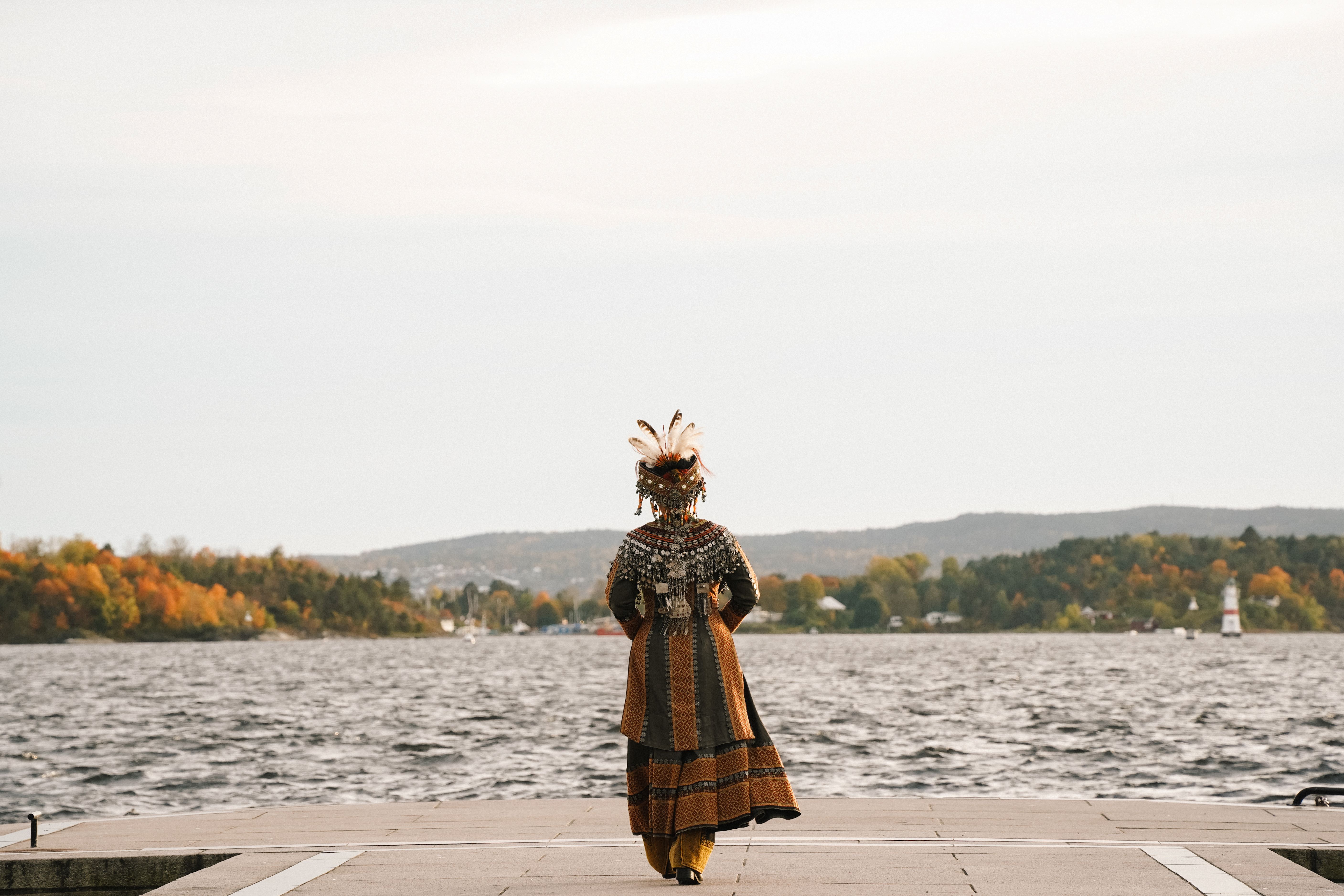
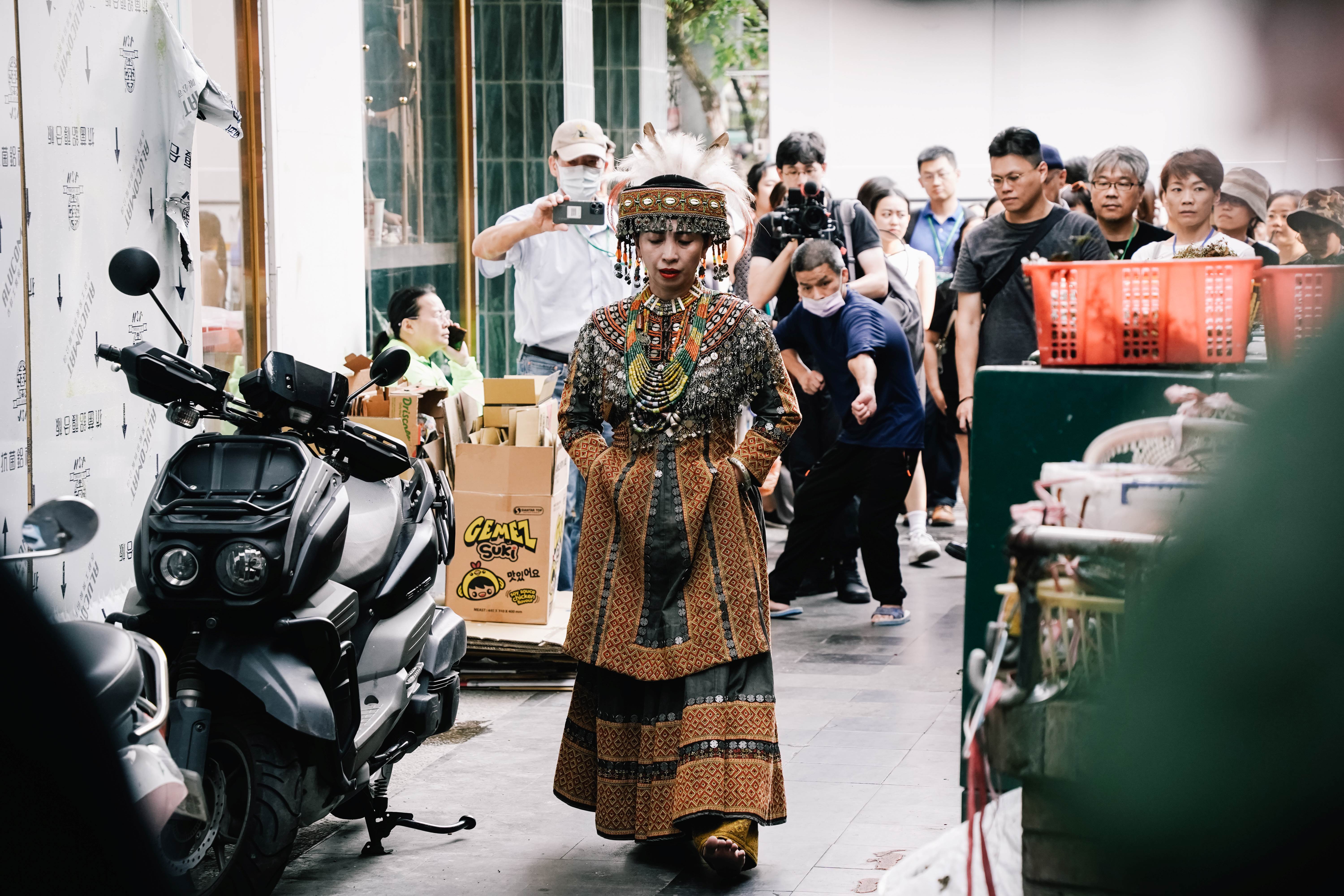
In Ljuzem’s Walk, Paiwan artist Ljuzem Madiljin walks slowly in 25 kilograms of full traditional dress, letting the weight and rhythm of her body call the land and ancestral spirits to be present. At its heart is a healing relationship between human and other-than-human, a ritual act through which the ancestral spirits descend and the land can be felt. Her female body, her steps, ancient songs, the Paiwan four-step dance, and moments of holding hands and touching with the audience weave together layer upon layer of affective bonds, as her body keeps forming new relationships with the land, the space, and the audience in the moment. At the end, Ljuzem takes off the heavy dress, as if each step has quietly changed the relationship between body, weight, clothing, and land. Walker and world shape each other: meaning does not exist beforehand but emerges only when body and surroundings touch. Walking is a way of knowing the world, telling history, and dwelling on the land, far more than getting from place to place. Ljuzem’s Walk reminds us that our relationships with spirits need a body to carry them, and that every walk is itself the drawing of a boundary.
In OH YA! Soul Food in the Mix!, Amis artist Fangas Nayaw starts from the most everyday act, eating, and blends community food, urban life, street circus, and bodily revelry into one. Performers chew and swallow with gusto, eating in an almost absurd bodily state, so that eating is no longer just about filling the stomach but becomes an amplified sensory ritual. Food trucks and circus acts gather on the street corner, and every choice (what to eat, how, and with whom) is bound up with relationships and ethics. The origins of food, the history it has passed through, and the labor and sacrifice it carries, the “spirits” that usually stay hidden, appear one by one in the performance. Meanwhile, the shared smells of cooking and the bodily memory of feasting together quietly awaken memories of ancestors, a sense of cultural identity, and a renewed sense of who we really are. Food here is both political and intimate, calling up the cosmic order as well as our most private sense of belonging. Echoing de la Cadena’s cosmopolitics, the work reminds us that food has never been mere matter but is an actor with a spirit, and that every meal is a cosmopolitical practice that asks for ethical awareness.
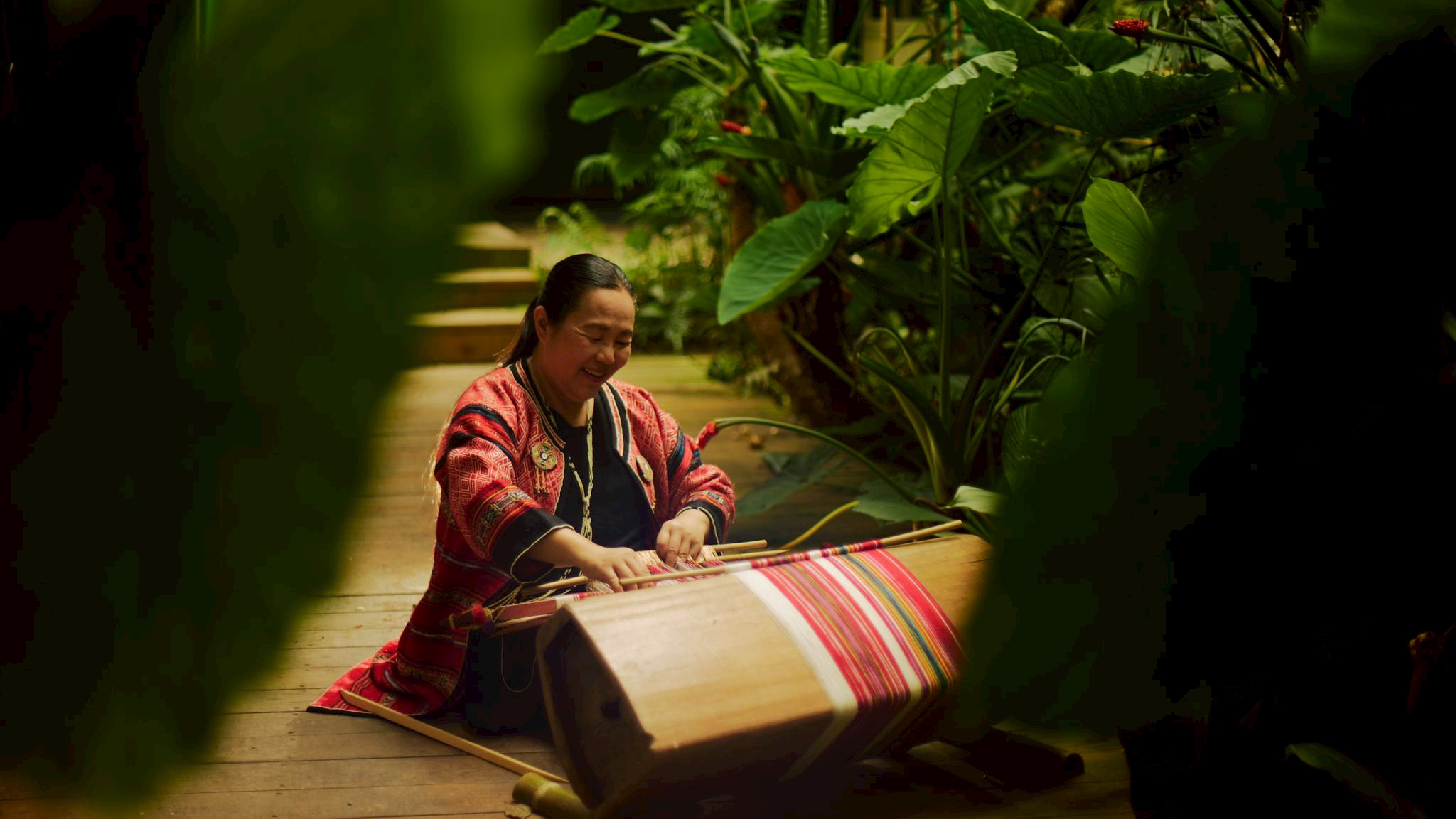
Bodies of Warp and Weft: Dimensions in the Making, a performance art work by women weavers of the pan-Atayal peoples, is an experimental work-in-progress that values process over result. It takes weaving out of the community and into a concrete plaza in the heart of the modern city, unfolding a bodily ritual built on the tension between physical labor and ancestral rules. Each time the weavers thread the yarn, push the reed, draw in the thread, and breathe and pull, their bodies practice Gaga anew. Gaga is a core Atayal concept that covers ancestral rules, the disciplines of daily life, and the covenant between humans and nature and between humans and the ancestral spirits; in itself, it carries the sense of taboo and boundary. Weaving is not only a skill handed down but the way the body remembers Gaga: every warp and weft is a conversation with the ancestors and a new drawing of the sacred boundary. The steady “thud, thud” of the reed striking the loom echoes between buildings, slowing down for a while an urban space used to speed, straight lines, and efficiency. Through everyday labor, the weavers’ performance reminds us that the spirit of craft lives in repeated bodily movements.
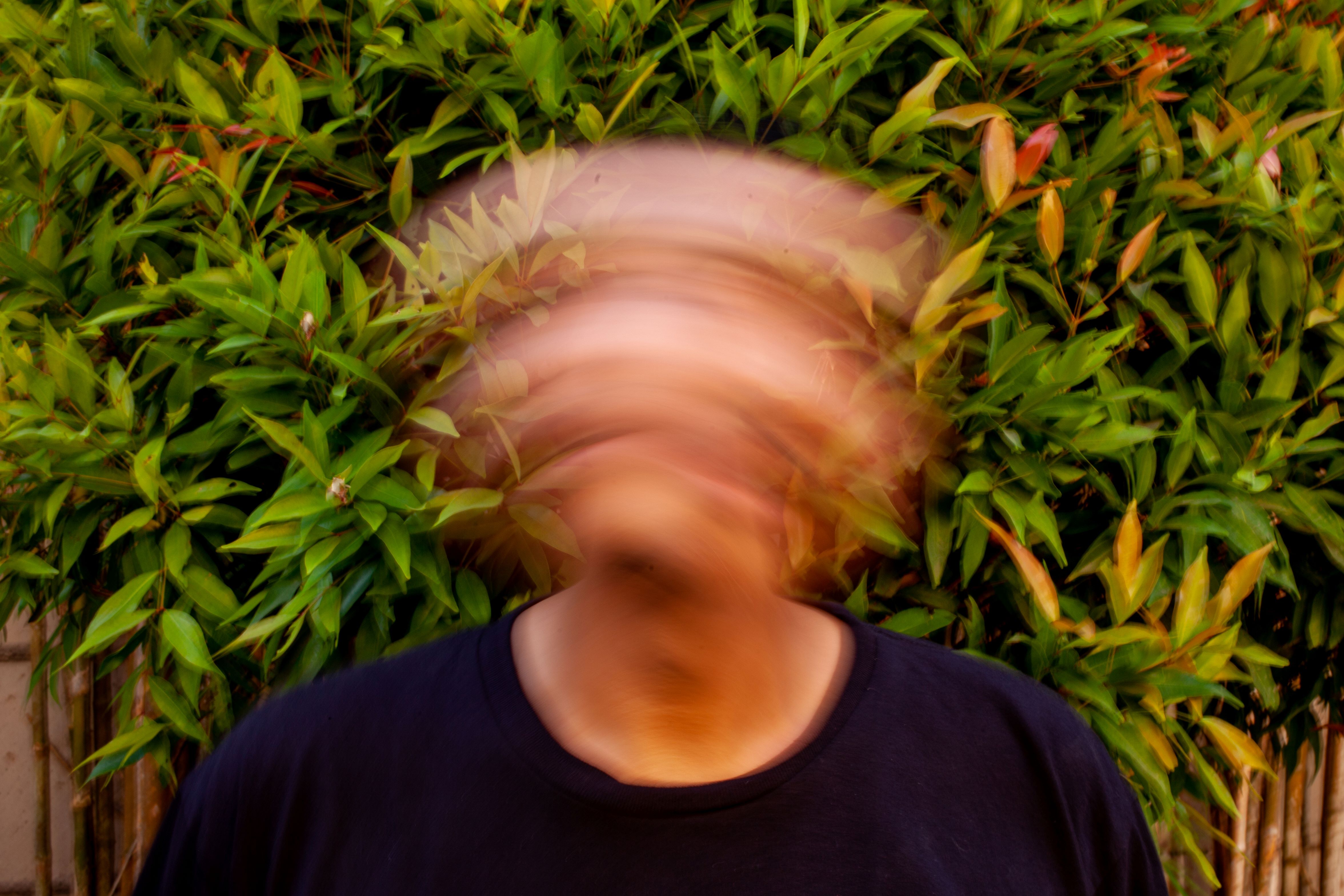
VOID ORIENTATION DISORDER brings together Indonesian and Australian artists with migrant workers in Taiwan. Starting from the Javanese view of directions, it explores how our sense of direction relates to the cosmic order. In Javanese cosmology, each of the four directions is guarded by spirits; direction is a spiritual order, not just a point on a map. Once migrant workers leave home for an unfamiliar city, losing their bearings is not only a loss of spatial sense but a break in their relationships with the spirits. Yet set in Taoyuan, where Indigenous peoples, migrants, and many cultures meet, the work goes beyond representing Javanese spirituality. It speaks to a more universal condition today: people are increasingly losing the ability to build relationships with the world they live in. The work unfolds around orientation, as performers slowly converge from all four sides of the stage; their bodies become coordinates, guiding spirits home.
The Performance Site as a Sacred Boundary
The festival’s four works come from different cultural universes (Paiwan, Amis, pan-Atayal, and Javanese), yet they share a core ontological turn. They refuse to reduce the world to affairs between human subjects, and insist that other-than-human beings (the land, ancestral spirits, the spirit of food, the spirits of direction) are real participants in the web of relationships.
The performance site becomes a sacred boundary opened through ritual. It marks out a sacred time and space where relationships that usually go unseen can briefly take shape. It invites all living beings to be guests, while making clear that this moment is special. It asks us to consider that viewers who step inside this boundary do not just come to “watch” a performance. They are invited to become part of the web of relationships: called by the walking body, watched by the spirit of food, drawn in by the rhythm of weaving, and shaken by the disorder of directions.
This is where Sentient Guests and the spirit of MASA’OPO meet most deeply: gathering is not only people meeting people, but an invitation for all beings to appear, to be acknowledged, and to be present together. Walking, eating, worlding: three gestures, three ways of opening up space and the world, three conditions that make a gathering a truly cosmic gathering.
The festival itself takes place outdoors, open to the sky. Sun, clouds, or rain, all living beings come as guests in their own way: on the grass, on the performers’ bodies and traditional dress, in the earthenware vessels and the aroma of food, becoming part of the web of relationships. The sky, the clouds, and the moisture in the air all join this cosmopolitical practice.
All beings, all living creatures, all things, all phenomena, and the whole teeming world are coming as guests.
Ljuzem's Walk in Daxi
Ljuzem Madiljin × Tjimur Dance Theatre
Date & Time|11.01 (Sun) 16:00
Venue|Daxi Old Street
Meeting Point|Yong Zhen Xiang Bakery
How to Attend|Follow the performer freely through the streets
Format|Outdoor / promenade
Taiwan–Indonesia Co-production: VOID ORIENTATION DISORDER (VoD) B.M. Anggana
Date & Time|11.07 (Sat) 17:30
Venue|Taoyuan Arts Plaza (Taoyuan Arts Center)
Admission|Free
Format|Outdoor
Content Advisory|Strong sound and light, flashing lights; ritual or religious content
Bodies of Warp and Weft: Dimensions in the Making
行為藝術
Date & Time|11.07 (Sat) 18:30
Venue|Outdoor Stage, Taoyuan Arts Center
Forma|Outdoor / seating on the ground
Content Advisory|Audience interaction
OH YA! Soul Food in the Mix!
Fangas Nayaw × Fist & Cake Production
Date & Time|11.08 (Sun) 14:30
Venue|Front Plaza, Taoyuan Arts Center
Format|Outdoor / standing for long periods or seating on the ground
Content Advisory|Audience interaction