

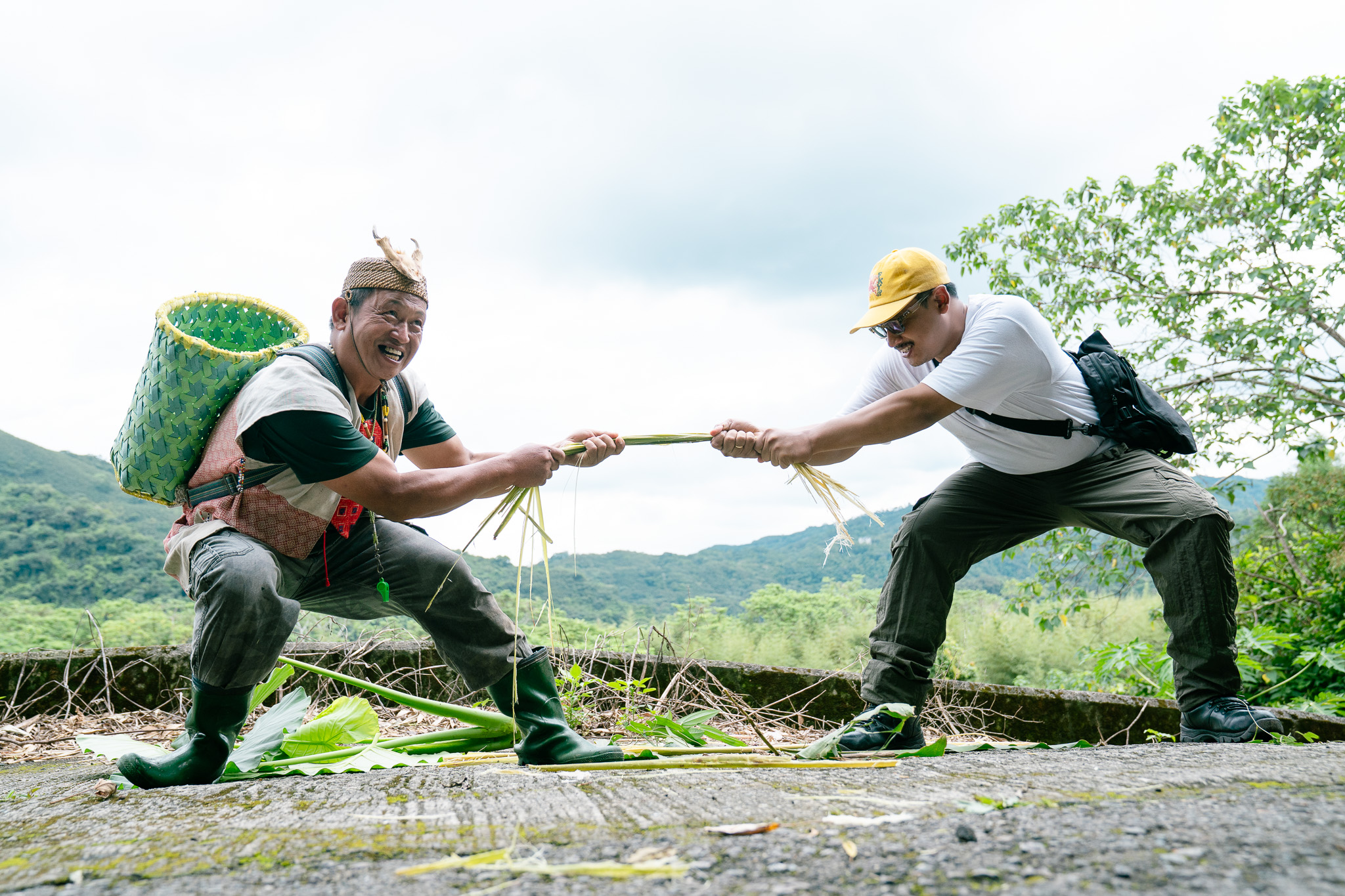
B.M. Anggana
When do we find ourselves? Is it when we are alone in the silence of a tropical forest? Or when we suddenly find ourselves displaced, becoming strangers to a new reality? Or when we walk alone through a city moving too fast? Or perhaps parts of ourselves are found in other people: someone we have just met, someone we have known for a long time, even someone whose language we do not understand? I did not deliberately carry any of these questions with me when I left for Taiwan. They came later, after several cities, an all-night ritual, a string of unfinished keywords, and a plaza I failed to get to know because the rain suddenly came.
Three days before I was to take part in a Pangcah ritual in Hualien, my good friend Joyu Hsu gave me a rather specific mandate: do not eat any meat, except pork. The problem was, I was still in Java, and I cannot eat fruit and have spent most of my life making peace with only a handful of vegetables.
On August 16, the day before my departure, I was still in Jakarta, wrapping up Sinsigus in 4#, a performance by Fioretti Vera at the Salihara International Performing Arts Festival. My body was still carrying the residue of the performance, my suitcase had to be packed, Taiwan was waiting, yet the problem occupying a surprising amount of my mind was painfully practical: what am I going to eat? Of course, I followed Joyu’s instruction without asking too many questions.
My journey to Taiwan, from August 17 to 23, was part of the development of Void Orientation Disorder, a work I am preparing for the MASA’OPO Festival. I shorten it to VoD, deliberately borrowing the sound of Video on Demand. There is something unsettling to me about that abbreviation. We live in a time when so many things can be summoned on demand: food, transportation, films, music, information, even conversation. A blue dot on a smartphone screen can tell us exactly where we are, while another coloured line shows us the fastest route to where we want to go. Technology has become increasingly sophisticated at helping us locate ourselves, yet I am drawn to the possibility that our problem is no longer simply the fear of losing our position. We may know exactly where we are, but not always what we are in relation to.
Something along those lines may have been what led me to Sedulur Papat Lima Pancer, a Javanese philosophy I had known of for a long time but had only recently begun to approach more closely. I am not interested in turning it into an ornament for claiming that the work I am developing “promotes Javanese tradition.” What unsettles me instead is how this philosophy sees human beings as never standing alone. There are four, and there is the pancer (the centre, or central point); there is birth, the body, direction, something that accompanies us, something visible and something unseen. The closer I move towards it, the more it feels like a way of orienting one’s existence through relations.
Lately, I have been exploring it as a kind of inner technology. The term admittedly sounds strange, perhaps too contemporary for something far older than what we understand as technology today. We are accustomed to imagining technology as something outside the body: smartphones, computers, satellites, algorithms, artificial intelligence. We create devices to extend human capacities: to see farther, move faster, store more, remember longer. Almost every limitation seems as though it could be solved by yet another device. But what if human beings also carry some kind of super-technology within themselves? What if the things we think of as human limitations are merely encrypted codes whose proper prompts and commands we have yet to discover? I do not know either. Perhaps that is also why this work, for me, is not about finding a definition, but about a long journey of experience. And sometimes, the journey has to move quickly.
On August 17, I flew from Jakarta to Taoyuan. The next morning, I was already on a train to Hualien. The following day I returned to Taoyuan, then moved on to Taipei the day after that, entering another space, meeting other people, hearing other stories, and suddenly I was already back in the place where I was born. In such a short span of time, the body moved faster than memory. Before it could even begin to understand one place, it was already being asked to learn how to read the next. We have remarkably precise measurements for calculating the movement of bodies. But I have yet to find a unit precise enough to measure when an experience truly arrives within us.
Of the week I spent travelling, the twenty-four hours in Hualien may have been the most complete experience I had.
In Hualien, time seemed to take on a different measure. I visited a Pangcah ancestral grave and spoke with AMA? about ancestors, tradition, cosmologies, and the Pangcah New Year ritual that would take place later that night. Around midnight, the Pangcah men began gathering around a fire. They came in traditional clothing; some wore Nike sneakers, and I noticed an Apple Watch glowing on one wrist. I liked the sight of it without feeling the need to immediately understand why. Not everything has to be turned into a symbol right away, does it? The ritual began. A shikawasai (a Pangcah shaman) led the procession; bodies linked together, bent forward, feet struck the ground, then moved and sang in a circle. The singing continued from around midnight until morning, while I sat there with a capacity to understand that was far shorter than the duration of the ritual itself.
I did not understand the language being sung. I only came to understand many things after someone explained them to me once the ritual was over; some I may have misunderstood, while a few terms I could only write down based on how they sounded to my ears. So the little notebook I bought at FamilyMart became a place to put down what my memory could not keep up with: ancestral house, ancestral grave, rice, blood, plants, cardinal directions, spirits, pig, betel nut, circle. But after a few pages, my hand was no longer simply recording what other people were explaining. It began to smuggle my own questions in between.
Rice, for instance. It was not simply something to be eaten, but was also made into rice wine, used as part of an offering, a material presence connecting people with their ancestors. I also noted blood as a connection to kinship and ancestors, as well as several plants that held particular importance for the Pangcah: bamboo, banana, yellow rattan, and cogon grass. In the middle of these notes, I suddenly found myself writing in large letters: WHAT IS FOOD FOR INDIGENOUS PEOPLE? A question perhaps far too large for someone who had only been there for a few hours, but precisely for that reason, I did not want to discard it.
Until then, I may have been trapped in a rather simple way of imagining food: something exists outside the body, then comes to us, is eaten, enters, and is processed by the body. In Hualien, that line began to branch out. Food is planted, harvested, fermented, eaten, shared, offered; it can connect the body to the land, one person to another, the living to those who came before them. Only then did I remember Joyu’s instruction not to eat any meat except pork. Apparently, my body had already been asked to enter a set of rules that my mind was not yet able to understand.
In my notebook, I wrote: reconnect with nature. Underneath it: does being connected to nature also mean being connected to ourselves? I then thought of Fritjof Capra and systems thinking. Together with Pier Luigi Luisi, he describes it as a way of thinking in terms of relationships, patterns, and context. From this perspective, a living system cannot be understood simply by breaking it down into its parts; its essential properties emerge through the interactions and relationships among those parts.1 That night, the idea did not appear to me as a diagram. It appeared through bodies linked together and an energy connected to the ancestors.
The next day came the Pangcah understanding of the four cardinal directions. I wrote down north, east, south, and west, each with a different relation to spirit. On the same page, I wrote: CIRCLE AND CIRCULAR. Four directions and a circle were, of course, tempting for someone who had spent months approaching Sedulur Papat Lima Pancer. Four there, four that I had brought with me. Directions there, directions I had been tracing. Ancestors, circle, body.
My mind began to work like someone finding pieces of a puzzle under a table. One by one, I picked them up. What if this was connected? What if those things could be brought together? What if there was something that had all along remained hidden between Pangcah knowledge and the knowledge I had been tracing in Java? But what if is a dangerous phrase. It can be the beginning of a question, but it can just as quickly disguise itself as an answer. And resemblance does not always mean relation. Things that appear similar do not necessarily grow from the same root. And what I had seen over the course of only a few hours certainly did not give me the right to understand a body of knowledge that had grown through tens, hundreds, perhaps even thousands of years of other people’s lives.
On the afternoon before I left Hualien, Kulas Umo, one of the shikawasai, said: “We only know our ancestor knowledge, not even one percent.”
I do not know whether one percent was an actual number or simply a way of measuring something that could no longer really be counted. But I immediately found myself calculating my own position. If they get one percent, how much do I get? Zero point zero something might already be too generous. Apparently, one really does have to travel quite far to be humiliated by oneself.
I was developing a work from Sedulur Papat Lima Pancer. I had been reading, discussing, and unpacking its various interpretations, even having the audacity to give it a new term: inner technology. But what did I actually know? What did I understand because I had experienced it, what had I acquired through reading, what had been passed down to me as stories, and what did I actually no longer know but still call “knowledge” simply because its name sounded familiar? On the last page of my Pangcah notes, I wrote: Question leads to another question. Meaning after meaning. We can get the big picture, but not enough to understand. Then, without explanation: Collective Co-Knowledge.
Those last two words kept bothering me. Perhaps knowledge never really resides whole within a single mind. Some of it lives in one person’s body, some in another person; in the way food is prepared, songs are sung, plants are named, in language, places, collective memory, or the story of someone who has died. At first, I imagined Collective Co-Knowledge simply as this: knowledge spread out. No one has to know the whole of it, because its parts may live across many people and many places.
But the more I thought about it, the less adequate the term began to feel. Knowledge sounded like something already complete, an object that could be broken apart and distributed among several minds. Through his idea of distributed cognition, Edwin Hutchins showed that cognitive work does not have to be completed within a single individual. In his study of ship navigation, he expanded the cognitive unit to include the coordination among people, devices, practices, and the environment in which the activity takes place. 2 I then began to wonder whether what I had recorded in Hualien was not simply knowledge spread out, but knowledge that became possible precisely because those relations were working together. Maybe the question was no longer where the knowledge resided, but how the knowing happened.
Perhaps that was why I began to shift it slightly towards Collective Co-Knowing. The shift from knowledge to knowing felt small to me in language, but quite significant in thought. Knowing is something that is happening. In studies of relational epistemology, I came across Pirjo Kristiina Virtanen’s research on land-based education among the Apurinã people in the Brazilian Amazon. There, knowing is discussed as a process shaped through relations with other people, places, land, the self, and even other-than-human beings.3 I am not using that idea to define the Pangcah; my experience was far too brief to make such a claim. Instead, it helped me reread my own notes. Perhaps knowing is not primarily a matter of possessing knowledge, but of taking part in the relations that make something knowable. I may have been able to bring the big picture home in my notebook, but the knowing did not necessarily come home with me.
At this point, I thought of Bruno Latour. In Reassembling the Social, he asks us to follow the associations that form what we call “the social,” including by not excluding objects and non-human actors from the story from the outset. 4 That idea unsettled the way I explained myself to myself. I began to wonder: if what I call the “self” also cannot be separated from a network of relations that is not entirely human, where exactly are the boundaries of an “I”?
I had set out imagining inner technology as something that works within the human being. But if the “self” itself is formed through relations with so many things outside itself, perhaps I had located the technology in the wrong place. Perhaps it is not the technology that resides within the human being; perhaps it is the human being who resides within a relational technology far larger than itself. I do not know yet. And perhaps I do not need to know yet.
I left Hualien, visited Taipei, then Fuxin, and returned to Taoyuan City. There, I faced a much more practical problem: I was running out of time to experience the site where VoD would be performed. The site was an outdoor plaza in the middle of the city. Because this work deals with the body, direction, distance, centre, and relation, I needed to spend enough time there. To walk. To sit. To listen to the sounds of the city. I needed more than the dimensions of the space; I needed to know how the space treated the body.
The problem was that the schedule was too packed. When I finally had a stretch of time completely free, I went there. I had barely arrived when it started to rain. I took shelter. Time ran out. And that was the story of me and the performance site: disorder and disorientation.
From Yogyakarta, I can still open Google Maps. I can look at satellite images, measure distances, ask for photographs, watch videos, and locate coordinates within a few metres of precision. In terms of information, I can know a great deal about a place without being there. But coordinates do not tell me how the wind moves between bodies, how the sound of traffic enters the plaza, where people tend to stop, or how a space changes after rain. Knowing a position is not the same as experiencing a place.
We too often think of a journey as a way of getting something. We travel in search of experience. We conduct research to acquire knowledge. We visit places to collect material. Artists now even work with a term that sounds convincing enough for all of this: field research. There is a field. There is research. And so it seems that once both are over, there should be something we have managed to bring home. I am not sure I brought anything home. At least not in that sense.
I returned from Taiwan without feeling that I “understood” the Pangcah, and perhaps that is how it should be. Nor did I return with any “big” answer about inner technology. What changed instead was my suspicion of the word “inner.” Perhaps that is why I called this piece On Journey of Soliloque. In theatre, a soliloquy makes someone appear to be speaking alone, giving voice to something that would usually only be heard within. But I began to wonder whether a conversation with oneself ever truly happens alone. When I speak to “myself,” whose voices are actually speaking with me? Parents, ancestors, language, the places where we grew up, books we have read, someone we met only the night before, the ground beneath our feet, or a voice that has been there from the beginning, until we mistakenly came to think of it as our own?
And so I returned home with more or less the same question I began with: when do we find ourselves? After this journey, I do not feel any closer to an answer. Instead, I have begun to suspect the question itself. Perhaps the “self” is not something lost somewhere, waiting to be found one day. Perhaps it is continually assembled, taken apart, and brought together again through relations—some of which we choose, while others were already there long before we arrived. Perhaps this is what, for now, has emerged from this journey: I travelled far enough in search of a way towards myself, only to return home suspecting that, deep inside, there had never been only me to begin with.
Bantul, 21 September 2026
¹ Fritjof Capra and Pier Luigi Luisi, The Systems View of Life: A Unifying Vision (Cambridge: Cambridge University Press, 2014).
² Edwin Hutchins, Cognition in the Wild (Cambridge, MA: MIT Press, 1995), xii–xiv.
³ Pirjo Kristiina Virtanen, "Relational Epistemology and Amazonian Land-based Education: Learning the Ideas of Intra-dependency in the Central Purus River," Anthropology & Education Quarterly 53, no. 4 (2022): 341–356.
⁴ Bruno Latour, Reassembling the Social: An Introduction to Actor-Network-Theory (Oxford: Oxford University Press, 2005).