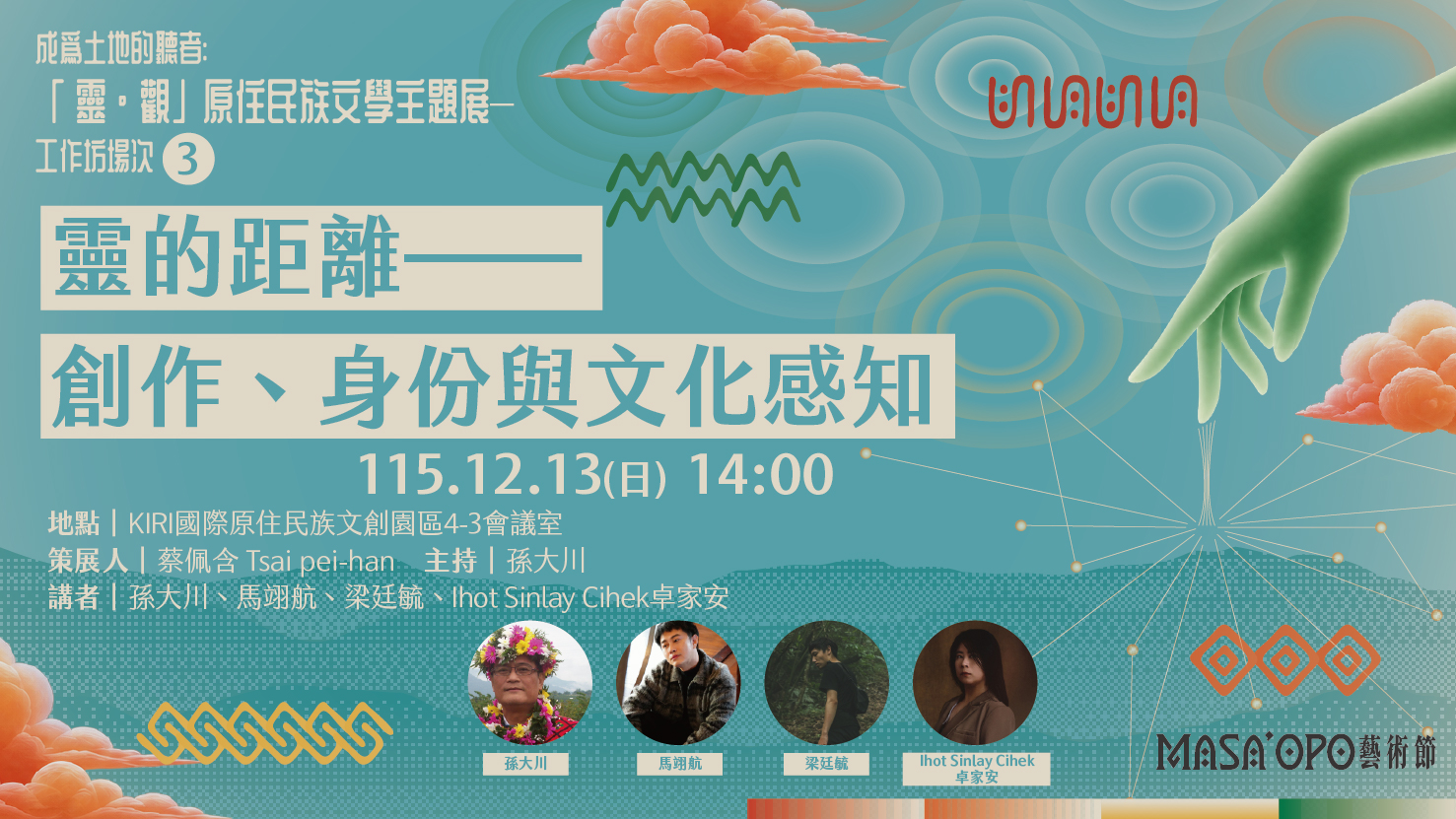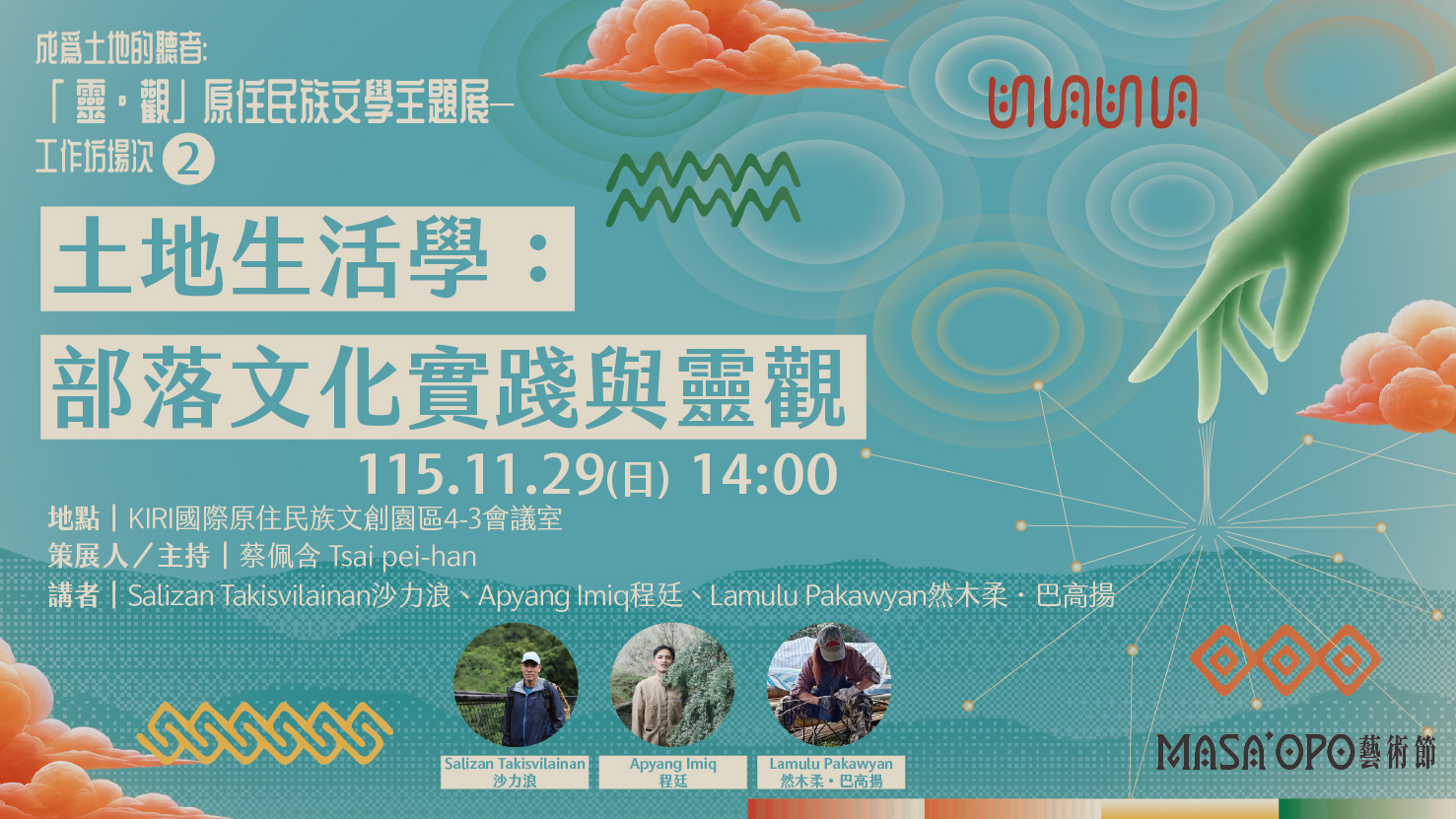

Curator |Tsai pei-han
Becoming Listeners of the Land: Reading Beyond the Seen — Indigenous Literature Exhibition
“Through migration, new things keep welling up before your eyes—and in those moments, only those whose hearts are awakened and clear can read the message the wind carries.”
— Dadelavan Ibau, Farewell, Eagle
The annual theme of the MASA’OPO Arts Festival, Pause. Listen. Beyond the Seen, takes its cue from masa’opo, “to gather,” opening a space where we can meet one another and where, through the living process of meeting, all kinds of new relationships can take shape. In the Chinese title, 聆—靈—聽, each of the three characters can stand on its own: 聆 (to listen), 靈 (spirit), and 聽 (to hear). Rearranged and recombined, they yield layers of meaning: the passive state of the senses receiving, and the bodily act of attentive seeking. Once “spirit” enters as what is being listened to, listening becomes more than the passing of sound; it opens a path that runs both ways. “Spirit” may be the soul, the heart and mind, a flash of inspiration, or a spiritual sensibility; it may also be all the living beings that dwell throughout the cosmos. 聆—靈—聽 thus becomes a new mode of awareness and perception, inviting us to feel anew the subtle yet profound relationships between one life and another, between people and other species, between people and the land, and between people and the cosmos.
Indigenous literature offers a path into these living relationships. It calls on us to learn anew, and to ask once more where “humans” belong among the land, all beings, and the cosmos.
Indigenous ritual songs, together with myths and legends passed down over thousands of years, carry the wisdom and humility of living in interdependence with the natural world. In the world of myth, people and nature were one from the start: the land holds its own memory, and mountains and rivers are never mere backdrop. Interaction and coexistence between people and “spirit” unfold across mythic, ritual, and everyday spaces, running through the spiritual core of a culture. Yet Indigenous literature does more than lead us back to tradition. It asks how, after colonization, migration, diaspora, loss, and rupture, we might find ways to converse with “spirit” again in the present.
Since the 1980s, Indigenous writers have taken up Chinese as a tool to record voices centered on their own peoples, writing down their own experiences and the collective memories of their communities. This writing responds to the ruptures of language, culture, land, and identity left by colonial history. At the same time, it becomes a way back to an inner spiritual homeland, and a reminder of how such a way of life might still be lived today. These works are not merely nostalgic. More often, they wrestle back and forth between city and homeland, between the modern and the traditional. Colonial history brought upheaval and displacement, and the loss of language, culture, ritual, and land has left many without real room to “be Indigenous.” In response, these writers turn outward to protest and critique, and inward to reflect, seeking shelter for fractured identities and cultures.
“Becoming listeners of the land” is a stance of humility. “Becoming” points not to a fixed identity but to an ongoing process of moving, adjusting, and learning, and to the possibility of opening dialogue again and again. This exhibition therefore traces how Indigenous writers, each along their own life path, have found different ways to sense the land, the ancestral spirits, and the natural world. Guided by these writers, we can rethink, through reading, how people and all beings are connected, and, in returning and looking again, learn to recognize where we stand and find our footing in the urban jungle.